
The number of fraud cases reported by private banks outnumbered those by public sector banks for the second consecutive year.

Credit card spending dropped 11 per cent sequentially in November at Rs 1.15 trillion, but topped Rs 1 trillion for the ninth month straight, data from the Reserve Bank of India (RBI) showed as the festive season ends and consumption activity slows down. Year-on-year (YoY), spending was up 29 per cent. Card spends have consistently topped the Rs 1 trillion mark, led by the rising share of e-commerce transactions.

Even as competition to garner deposits is intensifying into a tight liquidity and high credit growth scenario, Bank of Baroda (BoB) has hiked deposit rates for the second time in the current quarter. Also, private lender IDBI Bank has come out with a limited period offer on its term deposits. It is offering 7.6 per cent interest rate for a tenor of 700 days, effective from December 2022.

'There are unscrupulous traders who create fake invoices by showing bogus e-way bills, movement of goods.' 'Since the entities registered across different states, and kept on changing their numbers, tracing them was difficult.'

The regulatory changes brought in by the insurance regulator and the amendments proposed to the Insurance Act by the Centre may herald a new dawn for the sector in India. This may result in insurers bringing out more consumer-led products, top honchos of general insurance companies of the country concurred at the Business Standard BFSI Insight Summit 2022.

India has a huge untapped population which doesn't have facilities for financial aid and insurance, and it is perhaps plausible to look at the option of having niche players catering to smaller sectors akin to non-banks and microfinance institutions in lending, said Rakesh Joshi, member (Finance & Investment), Insurance Regulatory and Development Authority of India (Irdai). Speaking at the Business Standard BFSI Insight Summit, Joshi said, "Today, most of our insurance companies operate at a national level. There is arguably a case for having differentiated operations, which cater to niche sectors the same way we have non-banking financial companies (NBFC) and microfinance institutions in lending." "The capital requirement for niche players may not be as large as those having national ambitions. "Enabling these niche players, which require lower capital, will enhance the penetration in areas which hitherto had not seen traction from large players," he said.

Health premiums have picked up again after a slight moderation in growth, taking the non-life insurance industry's growth to 22 per cent in November, and to almost 17 per cent so far this financial year. Health premiums grew by 22.54 per cent in the April-November period, driven largely by group health plans, which have seen good growth due to rationalisation of discounts in premiums caused by adverse claim ratios in prior periods, medical inflation, and enhanced coverage. Health premiums grew by 29 per cent in the same period last year.
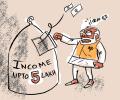
Policymakers are examining the possibility of increasing the tax-free slab to Rs 5 lakh in the two-year-old alternative personal income tax regime to make it attractive, a government official said. At present, taxpayers don't pay income tax if their taxable income is Rs 2.5 lakh and below. Increasing the threshold will reduce the tax outgo for assessees, thereby leaving more money with them to invest, the official said.

The bank has said rent payments will not earn reward points, and redemption of reward points on various cards have been capped in certain segments.

Crypto exchanges have been asked to furnish details this month itself.

The Centre is staring at a combined shortfall of up to Rs 1 trillion in excise and Customs revenues in the current financial year (FY23) compared to the Budget estimates (BE), mainly because of duty cuts on edible oil and petroleum products. The government set a target of Rs 3.35 trillion for excise and Rs 2.13 trillion for Customs mop-up for FY23 while presenting the Budget in February. "As excise duty collection is mainly driven by diesel volumes, we might see a clear gap in the level budgeted for FY23, following the reduction in cesses on petrol and diesel in May. We are expecting somewhere between Rs 80,000 crore and Rs 1 trillion dip in excise and customs duty collections," a senior government official told Business Standard.

The Central Board of Direct Taxes (CBDT) has proposed a new common income-tax return (ITR), with greater focus on disclosing income from virtual digital assets or crypto assets and foreign equity and debt instruments held by resident Indians. For non-resident Indians, the draft ITR seeks exhaustive details ranging from nature of business, permanent establishment (PE), business connection, whether the entity has significant economic presence (SEP) in India, along with the number of users in India. The ITR protocol for NRIs could widen the scope of the SEP principle that was introduced in the Finance Bill 2018-19, and the explicitly defined 'business connection' to include provision of download of data or software, if aggregate payments from such transactions exceed a prescribed amount, or if a multinational's interaction is with a prescribed number of users.

More than 24 prominent charitable institutions in the country - from private trusts, educational societies, statutory authorities, and cricket associations - may soon face tax scrutiny after a Supreme Court (SC) ruling set the limits to which tax exemption can be claimed. Most of these are highly profitable but get tax exemption due to their 'charitable organisation' status. The revenue department is preparing a standard operating procedure to scrutinise their books and evaluate if they can continue to claim tax exemption in the context of the recent SC ruling
Credit card issuers saw significant erosion of their card base during the July-September quarter as the Reserve Bank of India's (RBI) norms mandated deactivation of cards that have been inactive for a year. The second quarter of the current financial year saw outstanding cards-in-force decline by 2.55 million to 77.7 million. Prior to this, the industry, on an average, was witnessing a net addition of over 1.5 million credit cards a month as players became aggressive on the unsecured lending business after the pandemic.

It will also be new Revenue Secretary Sanjay Malhotra's first GST Council meeting. He will take charge after the incumbent Tarun Bajaj retires on November 30.

The grievances of as many as 2,500-3,000 taxpayers could be addressed and resolved between October 2 and October 31. The Central Board of Direct Taxes (CBDT) has asked tax officials to dispose of at least 20 per cent of the pending matters during the period. The move comes after Union Finance Minister Nirmala Sitharaman recently nudged the income-tax (I-T) department to redress the grievances promptly.

Amid fast-depleting forex reserves, the Finance Ministry on Wednesday signalled that it was not in favour of selling the dollar to defend any particular level of the rupee. "Let it (rupee) reach whatever levels it has to reach. We can't fritter away reserves on defending some artificial, imaginary rate of exchange," a senior finance ministry official told Business Standard. Forex reserves declined to a near two-year low of $545.65 billion as on September 16, down $85.88 billion from the level that existed on February 25, a day after Russia invaded Ukraine.
The outstanding credit card base dropped to 77.99 million in August from over 80 million in July, mainly on account of the new norms of the Reserve Bank of India (RBI) that warrant the deactivation of cards that are inactive for a year. While there was a 2.8 per cent decline in net card additions on a month-on-month (MoM) basis in August, a first in many months, credit card spends slipped 3 per cent on a high base. Still, spends topped the Rs 1-trillion mark for the sixth consecutive month.

The Director General of Goods and Services Tax Intelligence (DGGI) has slapped its heftiest tax notice of Rs 21,000 crore on Bengaluru-based Gameskraft Technology (GTPL) for allegedly evading GST on the betting amount. Gameskraft has dubbed the notice a "departure from the well-established law of the land". The company is accused of promoting online betting through card, casual and fantasy games like Rummy Culture, Gamezy and Rummy Time.

Come October 1, merchants, payment aggregators and acquiring banks can no longer store the card details of customers.
 © 2026 Rediff.com - Investor Information - Advertise with us - Disclaimer - Privacy Policy - Sitemap - Feedback - About us - Terms of use - Grievances